The box opens and takes the film with it
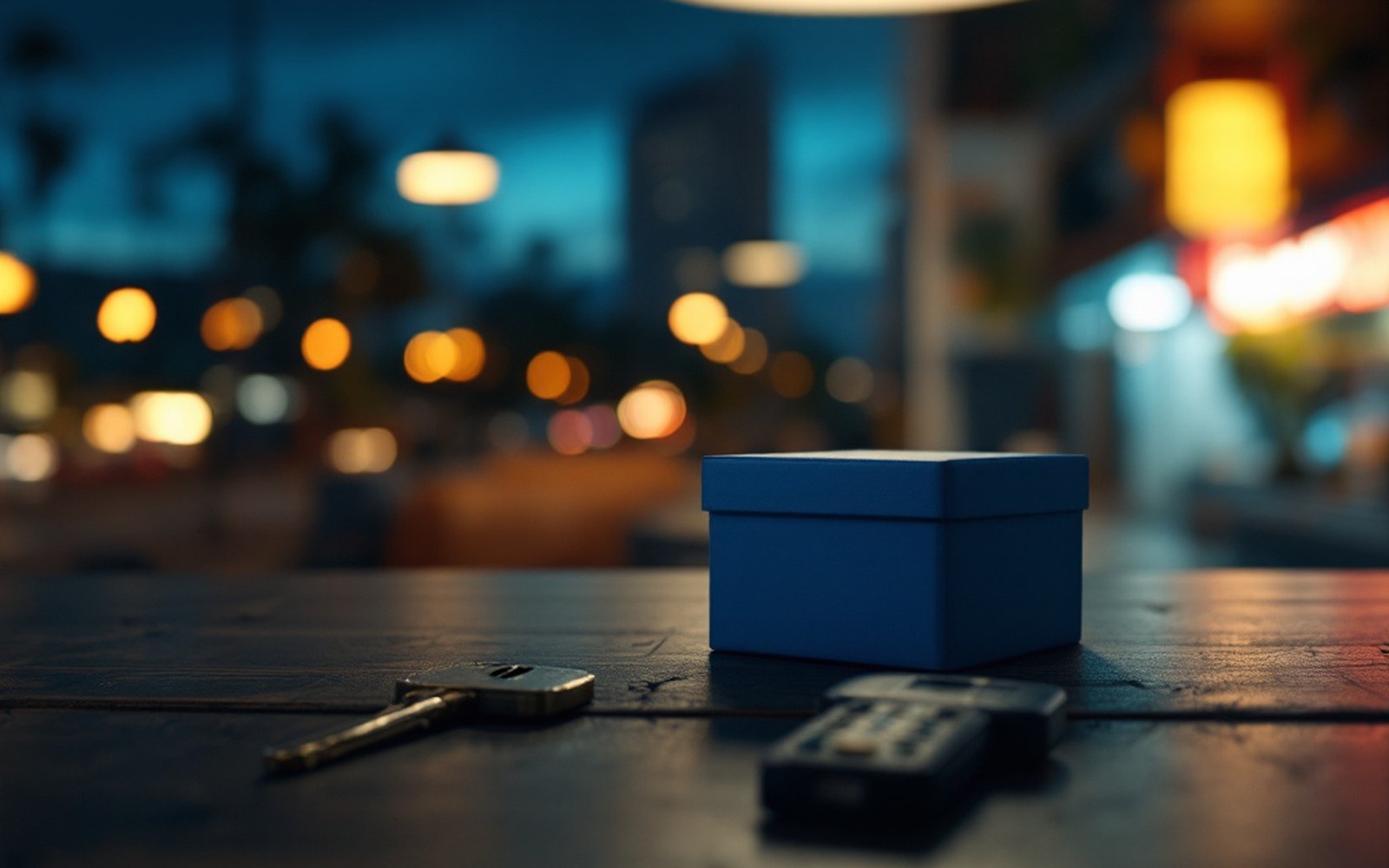
A blue box and a blue key. What happens when they meet is the hinge of the whole structure, and the film declines to say what either one is.
01 Two objects that do not explain themselves
The blue box appears in the first half of Mulholland Drive as a thing that Betty — the bright, apparently competent arrival from Deep River, Ontario, played by Naomi Watts — discovers in the apartment that is not quite hers. It is roughly the size of a hardback book, an intense midnight blue, sealed with a lock that has no visible logic. It is beautiful and it is wrong and the film registers both. The blue key appears later, materialising in the detective's bag as the apparent reward for completing the job. Where it came from is not explained. What the job was is not fully explained either. What matters is that the two objects are clearly, wordlessly meant for each other — the visual grammar is obvious — and that neither Betty nor her companion Rita, the amnesiac who took her name from a Gilda poster on a wall, treats the pairing as strange until it suddenly becomes the most frightening thing in the film.
When Rita opens the box, Betty is gone. There is a shot of the open box, empty. There is a shot of the apartment, empty. Then the film — not a scene, the film — tips over the edge. What follows in the second half does not continue the first. The locations are the same, the faces are the same, but the names have changed and the architecture of cause and effect has been replaced by something that does not behave like cause and effect. Critics working through the film's structure, notably in the sustained analyses gathered after its Cannes debut in 2001, have described this as the box acting as a structural detonator: whatever the first part was, the opening of the box is when it becomes something else.
02 The box inside the dream
The dominant reading of the film, set out at length by the critic Todd McGowan in The Impossible David Lynch (2007), is that the first half is a dream dreamed by the character who becomes Diane Selwyn in the second half — that Watts is playing two people and the optimistic Betty is a wish-fulfilment revision of the defeated, vengeful Diane. In this reading the box represents the repressed reality that the dream cannot sustain. Its colour rhymes with the blue key, which rhymes with the smaller blue key delivered to Diane in the second half, which itself rhymes with the shade of the box held by the mysterious dwarf-figure in the Club Silencio sequence. The box, in other words, is doing thematic work through colour long before it does structural work through plot.
McGowan's reading is careful enough to note that the dream hypothesis does not account for everything. No reading does — that is the working condition of this film, and Lynch has not publicly endorsed any interpretation over another. What the box undeniably does, whichever reading you prefer, is concentrate the film's anxiety about containers and contents. Rita's handbag is full of money and she cannot explain it. The diner at Winkie's conceals something behind it that destroys a man just by being looked at. The Club Silencio is a theatre in which performance and reality are forcibly separated — no hay banda, the emcee announces: there is no band, it is all recorded. Every significant object in the film is a wrapper around something that either cannot be shown or should not be opened.
The blue box is the most literal instance of this logic and the most violent in its consequences. When Rita removes the key from the detective's bag, she holds it up and the film holds with her: Peter Deming's cinematography keeps the key isolated, sharp against blur, for just long enough that the audience understands this is the moment. Angelo Badalamenti's score, which has been doing much of the film's emotional heavy lifting throughout — signalling dread and tenderness in alternation, often where the dialogue does neither — drops here into a low-frequency unease that resolves nothing. The sound design, too, has been noted for the way that the box, when it opens, appears to swallow the film's ambient noise rather than release it. Silence as an event rather than an absence.
03 After the opening
The practical effect of the box opening is that the film's sympathetic protagonist vanishes from the scene and, in a meaningful sense, from the film. Betty does not die in the conventional way a character dies. She is simply absent from the shot that follows her companion opening the lid. What replaces her and the dream-logic she inhabits is a second half that several critics, including those writing for Sight and Sound after the film entered that magazine's 2022 poll of the greatest films ever made — in which Mulholland Drive placed eighth — have described as closer to Greek tragedy than to thriller: a person destroyed by desire and by the machinery of the industry that was supposed to reward it.
The blue box, emptied of its contents and now itself absent from the second half, functions in retrospect as the point where the film admitted what it was about. David Lynch has spoken in general terms about the generative power of objects in cinema, about how a thing can hold a feeling that cannot be put into dialogue; the DVD insert that accompanied the film's original release included ten numbered clues for viewers, one of which draws attention to the red lampshade, but the blue box is not among them, which may be the most suggestive fact of all. The most load-bearing object in the structure is the one Lynch declined to gloss.
Whatever the box contains — guilt, a repressed truth, the self that was traded away — the film's argument is that looking directly at it is not survivable. Nothing that comes near what was inside it survives either, and the film does not pretend otherwise. The box does not close again. Neither does the film.