Winkie's is where the film shows its hand early
A man describes a nightmare about the place he is standing in, walks round the back to prove it is nothing, and the film does the thing he described.
01 The diner on Sunset Boulevard
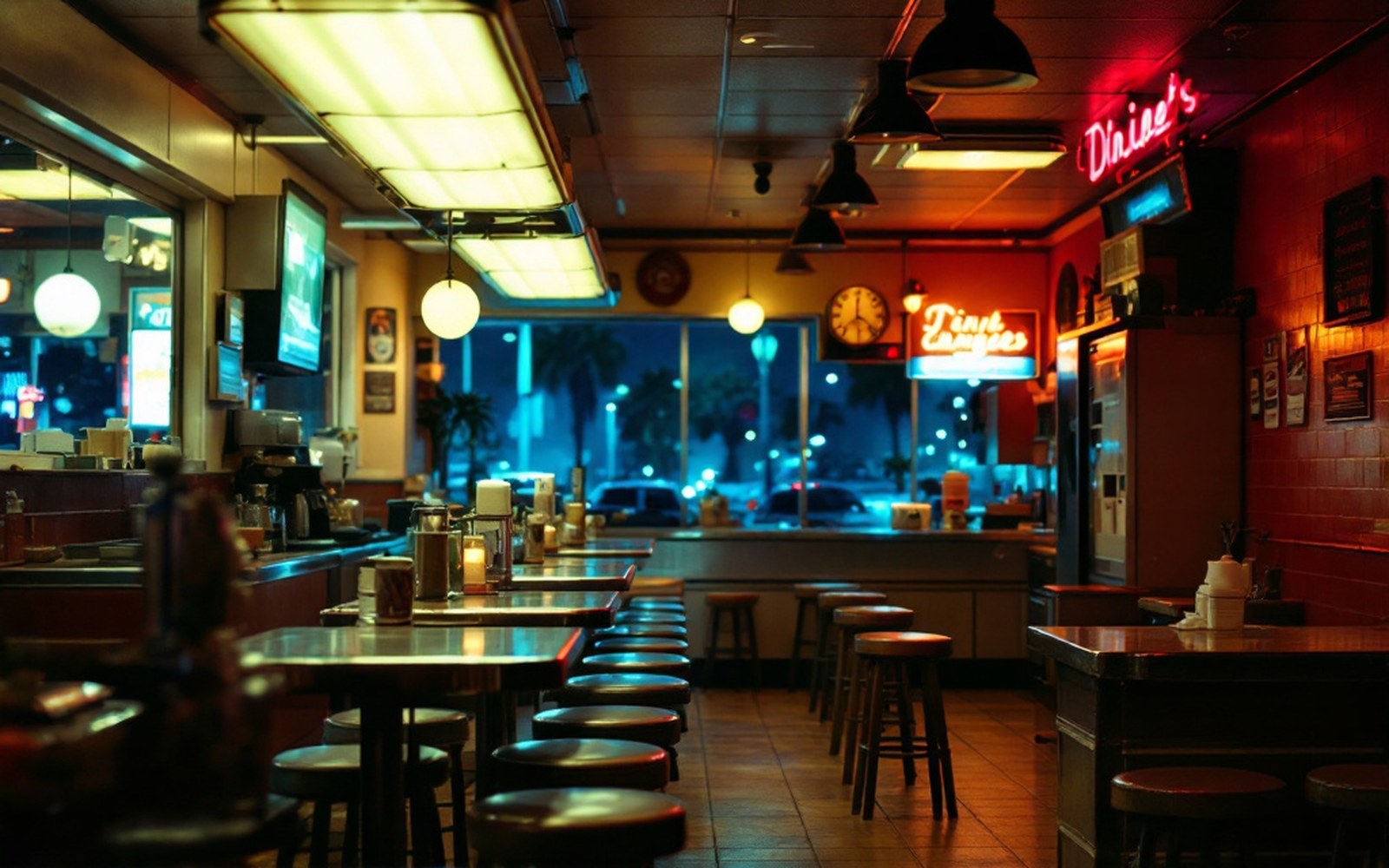
Winkie's is a chain diner on Sunset Boulevard, one of those Los Angeles institutions that looks exactly like itself at every hour — fluorescent, laminated, reliable. Lynch uses that familiarity as a trap. The scene arrives early, before the film's central characters have found their footing, and it behaves at first like an establishing insert: two men at a booth, coffee, daylight.
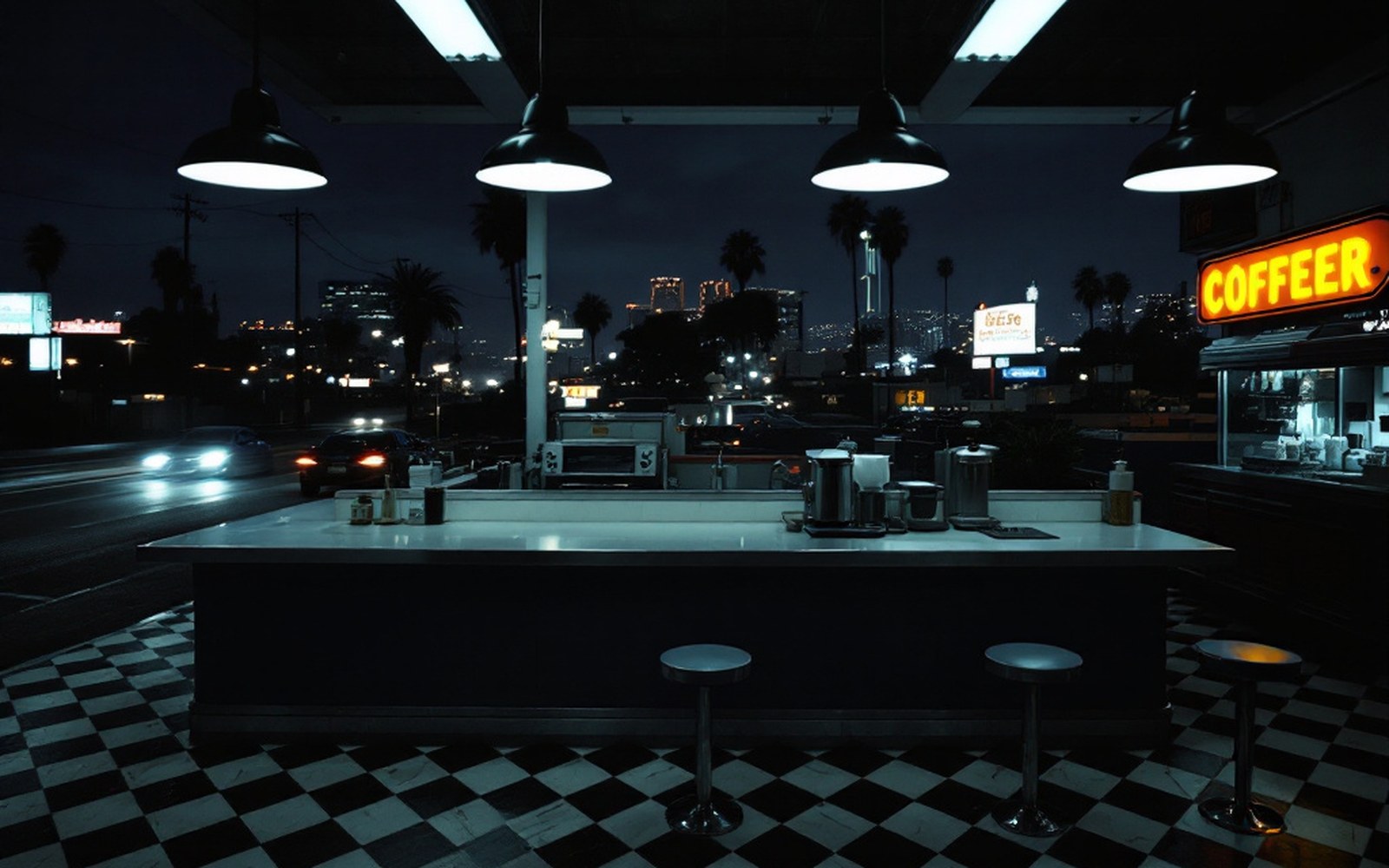
One of them, a young man identified in the credits as Dan, tells the other — Herb — about a recurring nightmare. In the nightmare he is here, in this Winkie's, in daylight, with another man sitting opposite him. He feels a terrible dread. He walks to the back of the building, behind the counter and out through the rear, because that is where the thing is that causes the fear. Then he wakes up. He wants to go around back now, in daylight, to prove the nightmare is empty — that the thing behind Winkie's is nothing.
They do. They round the corner. A figure steps out from behind the wall — a ruined, barely-human face under a grey hood — and Dan collapses.
02 What the scene is doing structurally
The sequence runs roughly three minutes and has little direct bearing on the main story of Betty and Rita. Dan and Herb do not return. Whatever narrative function this scene might have served has been stripped away, and what remains is almost pure mechanics: Lynch is demonstrating, in miniature and without ambiguity, how the whole film works.
He is showing a man describe an event, then enact the description, then have the description come true — in the same order, in the same location, with the same terrible precision. The first half of Mulholland Drive is full of moments that feel like they mean something without yet meaning anything. This one is a diagram of the method. The film splits at the ninety-minute mark into two irreconcilable halves, and the Winkie's scene is the earliest legible signal that what you see being described and what you see happen are not separate events but the same event looped back on itself.
The figure behind the diner — raw-faced, barely coherent as a human form, holding what looks like a brown paper bag — appears in the second half of the film in the hands of a different character, in circumstances that recast the whole economy of guilt and wish-fulfilment the film is running. Critics including Amy Taubin, writing in Film Comment, and Todd McGowan in his 2007 study The Impossible David Lynch, have read this figure as an externalized dread, a thing that belongs to dreaming rather than to waking Los Angeles. Neither reading forecloses the other. The scene is content to be both.
03 The sound design underneath it
Angelo Badalamenti's score drops away before the walk. What replaces it is the ambient sound of the diner — air conditioning, distant traffic — and then, as the two men approach the corner, a low oscillating drone that sits below music and below comfort. Peter Deming's cinematography gives the back of the building the same flat California light as the front, which is part of the cruelty. Nothing in the image changes. The horror is added entirely by the figure and by what the score does in its absence.
This is the thing the Winkie's scene teaches you, if you let it: Lynch's dread is not a genre effect applied to dark corridors. It lives in the gap between what a location looks like and what it turns out to contain. Daylight is not protection. The described nightmare and the witnessed one are the same nightmare. Dan knew. He just went anyway.