Silencio tells you it is a recording, then breaks your heart
No hay banda. There is no band, it is all a tape — and Rebekah Del Rio's performance collapses anyway, in front of two people who have just been told it is not real.
01 The theatre announces itself as a lie and then devastates you anyway
Club Silencio arrives in the first half of the film, past two in the morning, after a cut so abrupt it might itself be a splice. Betty and Rita — still Betty and Rita at this point, still inside the dream logic that governs the film's opening ninety minutes — find themselves in a crumbling red theatre with no audience and no band. A magician in a blue coat steps out and tells them exactly what is happening. No hay banda. There is no band. Everything they are about to hear is a recording, a trick, an illusion. The film is giving away the mechanism while the mechanism is still running.
This is the most candid scene in a film full of concealment. Lynch lets the magician spell it out: the trumpet you hear is on tape, the voice you will hear is on tape, the grief you are about to feel is constructed from recorded signals passing through a speaker cabinet. It ought to be inoculating information. It is not.

02 What Rebekah Del Rio does
Rebekah Del Rio walks onto the stage in a blue gown and sings a Spanish-language a cappella arrangement of Roy Orbison's "Crying" — here titled "Llorando," the Spanish word for the same thing. The arrangement strips the original of everything except its melodic line and its ache. Orbison's 1961 recording is built from orchestration and reverb and his extraordinary falsetto; Del Rio's version, as heard in the film, is a single voice in a hollow room. The hollowness is the point.
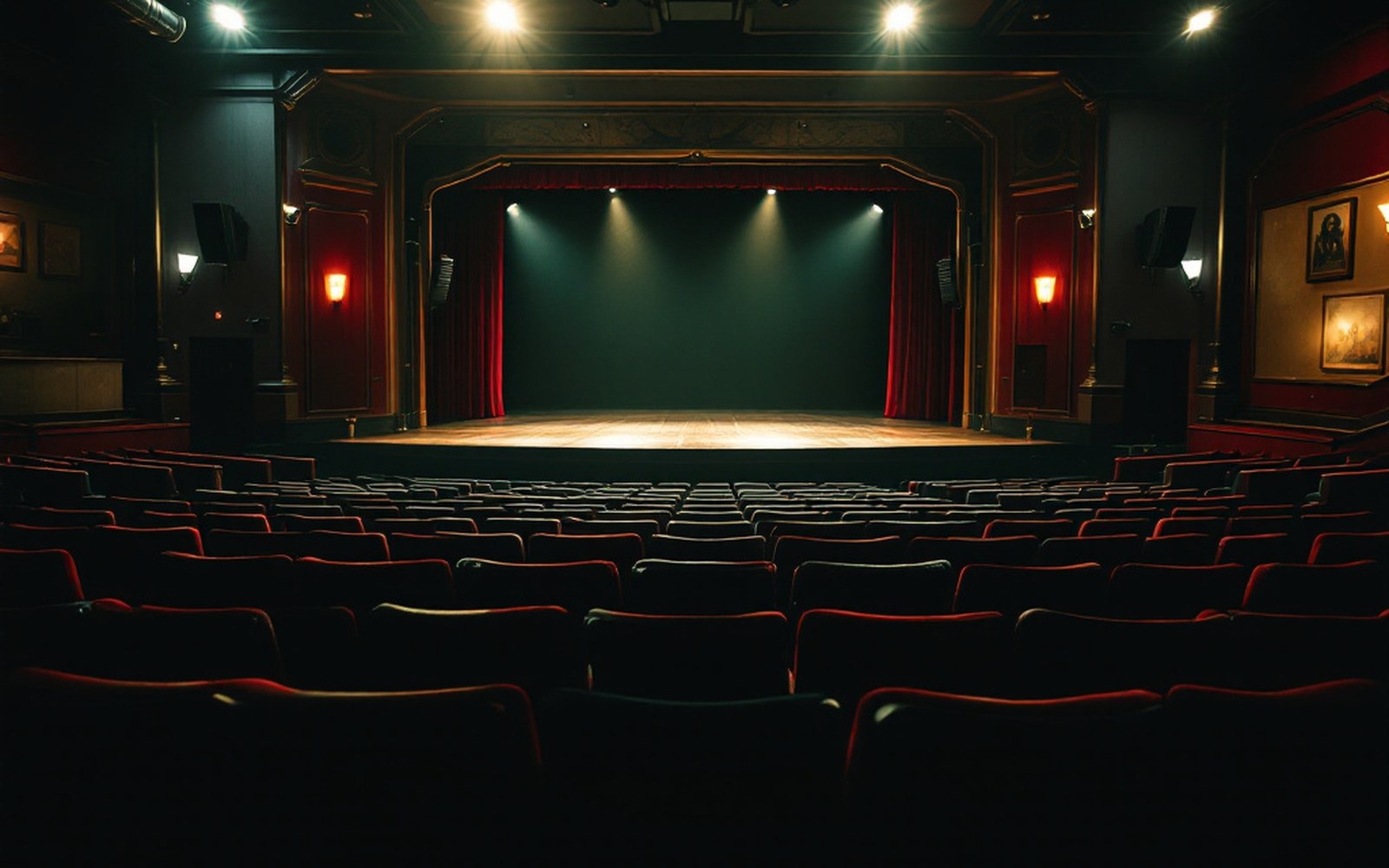
She sings for what feels like two or three minutes. Betty begins to cry. Rita begins to cry. The women in the audience — there are a handful, seated in the dark — appear moved. Then Del Rio collapses. She drops mid-phrase and is carried offstage. The voice continues. The voice was always on tape, as advertised, and it continues without her because it never needed her body in the first place. The song does not care that she has fallen. It finishes without her.
This is the scene that has accumulated the most commentary in the film's critical life. Critics have often read the Silencio sequence as the film's key to understanding how desire and loss are constructed rather than experienced directly, a reading that recurs throughout writing on Lynch. The observation is precise: the scene proves its own argument. Del Rio's collapse demonstrates, in real time, that the emotional content of a performance and the body producing it are separable. The song is real. The singer is contingent.
What makes this more than a conjuror's trick is Del Rio herself. She is not a Hollywood studio singer deployed for effect. Her appearance in the film is, by any measure, a genuine performance from a working musician, and the casting earns its result. When the voice continues after the body falls, the wrongness of it is visceral precisely because the preceding two minutes were not.
03 The box in Betty's bag
Something else happens at Club Silencio, and it is quieter than the singing. During or just after Del Rio's performance, Betty feels something inside her handbag. She finds the blue box — the object that, at the turn between the film's halves, the key unlocks, and that seems to take the entire architecture of the story with it when it opens. She did not put the box there. She does not know what it is. The scene gives no explanation and asks for none.
This detail locates Club Silencio precisely in the structure of the film. It is the hinge point. Before it, the film has been running in one direction; after it, the pressure that will break the dream open is already in Betty's hands. The theatre is the place where the film's two halves touch. The magician announces an illusion. The illusion produces real grief. The real grief contains a box whose opening will reveal that everything we have seen was itself a recording, of a kind — a dreamed version of a life, run forward until it becomes unbearable.

04 Why the scene lands in the first half
Club Silencio belongs, chronologically, to the film's first movement. Betty and Rita are still the characters we have been following. The scene is suffused with the first half's palette: deep reds, Angelo Badalamenti's low orchestral dread threading under the ambient sound of the empty house. But it does not play by the first half's rules. The television-pilot material that constitutes much of the opening hour is naturalistic in its genre conventions — a woman arrives in Hollywood, a mystery begins, two people follow a clue. Club Silencio is not that. It is the dream knowing it is a dream and choosing to sing about it anyway.
Badalamenti's score falls back once Del Rio begins to sing, because her voice replaces it. The silence around "Llorando" is structural. When the film has been most anxious about what is coming, the music has done the work of telling you. Here the music steps back and lets a recorded voice do it instead, which is consistent with what the magician has been saying all along: the emotion is always in the signal, not the body producing it.
The two women leave the theatre shaken and go back to the apartment. The tenderness of the hours before — the blonde wig that made Rita look, briefly, like Betty, the bed they shared — is already behind them. The film moves quickly after that toward the blue box, the shift, and the second half's different and colder logic.
05 What the scene costs
Club Silencio sets a trap and the trap is working sentiment. Lynch has shown you the mechanism, warned you against the response, and then produced the response anyway — in the characters and, by nearly universal report, in the audience. This is not a failure of the scene's design. It is the scene's argument: knowing that emotion is constructed does not protect you from it. Betty knows the voice is a tape. She weeps. Rita knows the voice is a tape. She weeps. You know the voice is a tape. The song continues regardless, and Del Rio is carried away, and the blue box is in the bag, and nothing that has been explained explains what you feel.
That is what the scene is for.